The Freelance Client Offboarding Checklist for 2026
Why the last 7 days of a freelance project are worth more than the first 30, the 9-step closeout that turns one-time work into referrals, and the testimonial-capture script that beats stock-photo headshots.
If repeat clients are where the money is, the last 7 days of a freelance project should be the most carefully run part of the engagement. Most freelancers run them as the worst part: rushed handoff, file dump, awkward "let me know if you need anything" email, then radio silence. This post is the 9-step offboarding checklist that turns a finished project into the next two — including the testimonial script, the referral ask, and the retainer pitch that converts inside the 2-week window.
Why most freelancers wing the closeout
Keep reading
Three patterns repeat:
The freelancer is mentally on the next project. The work shipped, the invoice cleared, the brain has already moved on. The closeout becomes a 5-minute task instead of a structured 90-minute process.
The fear of "asking for more" trumps the math. Asking for a testimonial, a referral, or a retainer at the end of a project feels like overstepping. The reality: 73% of B2B decision-makers say case studies significantly influence their purchasing decisions (G2 2025 Buyer Behavior Report) and 79% of buyers say they've been convinced by a video testimonial (Wyzowl Video Marketing Statistics 2025). The asks aren't overstepping — they're the highest-leverage part of the relationship.
The handoff is unstructured. Without a checklist, the closeout becomes "did I send the file? was the invoice paid? did I unshare the Drive folder?" — a series of partially-completed loose ends that the client notices even if the freelancer doesn't.
PMI's 2025 Pulse of the Profession found that professionals with strong project-execution power skills experience scope creep on 28% of projects vs 40% without (PMI Pulse 2025). Closeout discipline is one of those power skills, and it's the most-skipped one in solo freelance work.
The 9-step offboarding checklist
The full checklist takes 60-90 minutes spread across the final week of the project plus 30 days of follow-up. Run all 9 steps; partial closeouts are why repeat work doesn't materialize.
Step 1 — The handover packet (final day of project)
One zip / shared folder containing every asset the client needs to operate the deliverable without you:
Final files (production-ready, named consistently)
Source files (Figma, Sketch, .ai, raw video, .indd, etc.)
Brand assets, fonts, license files
A 1-page README: what each file is for, how to update it, who to call for what
Login credentials transferred to the client's password manager (1Password / Bitwarden)
Any third-party access transferred or revoked (Cloudflare, hosting, GitHub, analytics)
The README is the single most-skipped item. It's also the one the client will reference 3 weeks later when they need to re-export the logo and don't remember what file format you delivered.
Step 2 — The summary report (final day)
A 1-2 page document covering:
What was scoped at kickoff
What was actually delivered
What changed mid-project and why
The metrics or outcomes if measurable (page-load time before/after, conversion rate, user count)
Recommended next steps in 3 buckets: this quarter, this year, someday
Most freelancers skip the report. The ones who don't are the ones the client forwards to their boss with "this is who we should keep using." The summary report is the artifact that does the internal selling for you when you're not in the room.
Step 3 — The final invoice (final day)
Send it the same day you ship. Stripe-backed, click-to-pay. Late invoicing is the single fastest way to dampen a positive closeout — the client's emotional peak is when they receive the work, and that's the cheapest moment to charge.
Step 4 — The closeout call (within 3 days of delivery)
20-30 minutes, optional but high-leverage. Three sections:
5 min — walk them through the handover packet. Don't just send it; show it.
10 min — what worked / what didn't. "What was the most useful thing in how we worked together? Anything you'd want different next time?" Listen, write it down.
10 min — what's next. "Here's what I'd recommend you do in the next 30/90 days. Some of it is in your scope; some is in mine if you want me to keep going."
The closeout call is where the retainer conversation happens naturally. Skip the call and you have to engineer the conversation cold via email later — much lower conversion.
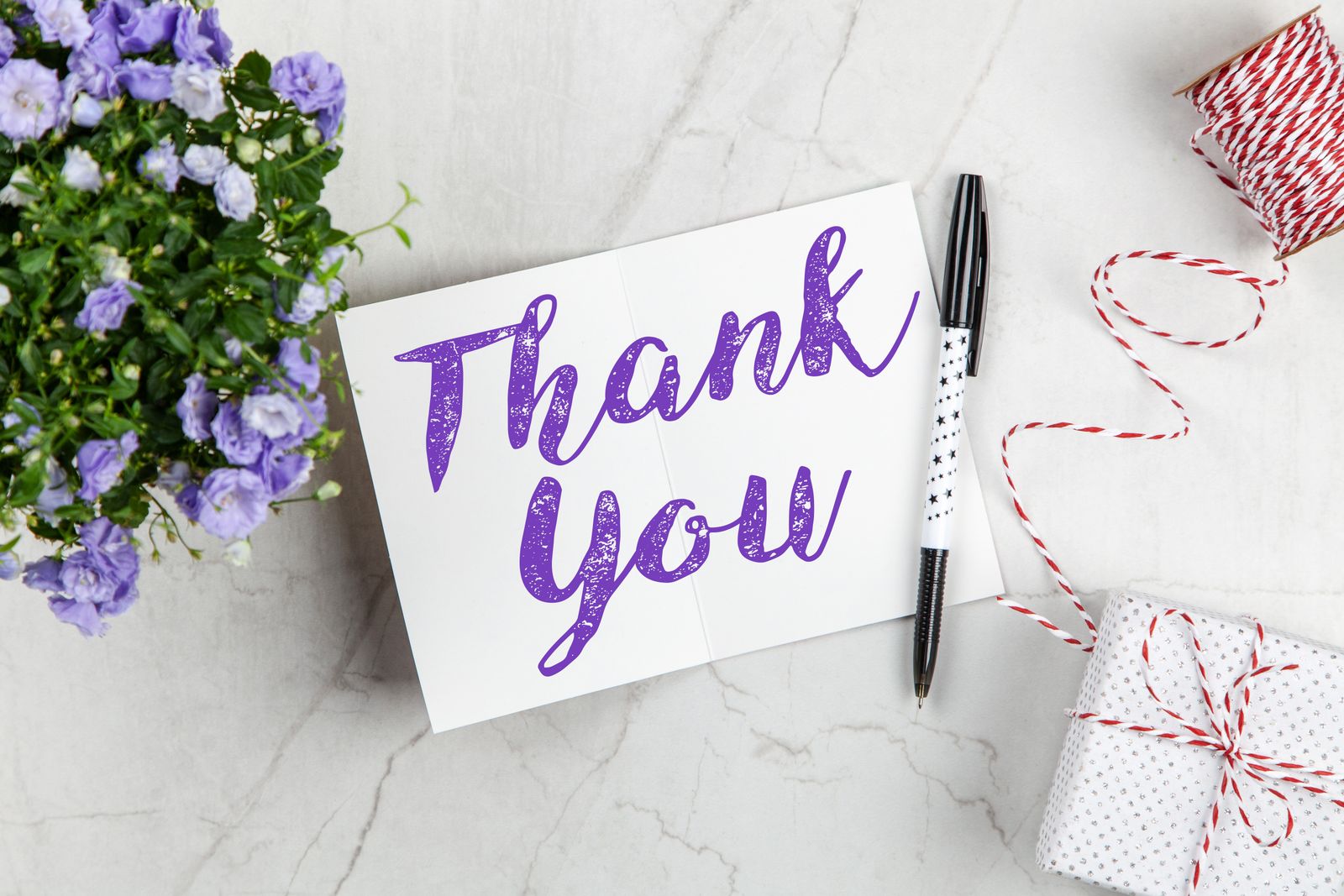
A handwritten 'Thank You' card on a desk — the kind of small gesture that turns a finished project into a referral
Step 5 — The testimonial ask (within 7 days of delivery)
The client's enthusiasm peaks in the first week after delivery. After that, it fades fast. Send the ask while the work is fresh:
Hey [Name], thrilled with how the [thing] turned out. If you've got 2 minutes, would you mind sending me a quick testimonial I can use on my site? Doesn't need to be polished — even a 3-sentence email is great. Three prompts in case it helps:
>
1. What problem were you trying to solve? 2. What did we ship together that fixed it? 3. Would you recommend working with me — and if so, to what kind of person?
Three prompts is the magic number. Without them, the client writes a generic "great to work with" line you can't use. With them, you get a structured 4-paragraph testimonial that doubles as a case study.
For the highest-converting variant: ask for a 60-90 second video testimonial via Loom. 79% of B2B buyers say video testimonials convince them to buy (Wyzowl 2025) and clients who are willing to record one are also the ones most likely to refer.
Step 6 — The referral ask (day 7-10)
A separate email, not bundled with the testimonial:
Hey [Name], one quick ask — if you know one person in [their industry / role] who's working on [the kind of problem you solved], would you mind a 1-line introduction? No pressure if nothing comes to mind, but cold-finding clients like you is much harder than warm-finding them, and one intro from you is worth dozens of cold pitches on my end.
The reason it works: it asks for one thing, frames it as low-effort, and is honest about the lift to your business. Most clients say no out of vagueness — "I can't think of anyone right now" — and a third of them come back 2-4 weeks later with an introduction once someone happens to mention the topic.
Step 7 — The retainer pitch (day 7-14)
This is the conversion-window pitch covered in detail in our retainer playbook: a specific shape, a specific price, a clear out. Pitch a retainer to every client whose work could plausibly continue. Even at a 25% conversion rate, the math is unmissable.
Hey [Name], how's the [thing] holding up a month in? Any quick wins or anything that needs adjusting? Happy to take a look on the house — just curious how it's settled.
Two reasons it converts. First, "on the house" gives you a frictionless way to be back inside the project. Second, the client's first month of using the deliverable surfaces edge cases that often turn into a paid extension. Roughly 1 in 4 of these emails leads to a follow-up engagement, in our experience.
Step 9 — The 90-day NPS / survey
A single question, sent 90 days after delivery:
On a scale of 1-10, how likely are you to recommend working with me to someone in your network?
That's it. No extra fields. The B2B agency-and-consulting NPS benchmark sits at 59 (Retently 2025 NPS Benchmarks) — anything below 7 is a churn signal you need to act on; anything 9-10 is a referral lead waiting to happen. Follow up on the 9-10s with a referral ask.
Three carefully wrapped gifts on a wooden surface, symbolizing the closeout package a freelancer hands a client at the end of an engagement
What to send (and not send) in the closeout email
The closeout email itself is short and structured. The losing version is a 4-paragraph "it's been amazing working with you" wall that nobody reads.
The winning version:
Subject: [Project] — final delivery + handover
>
Hey [Name],
>
Wrapped! Final files + summary report attached, and the credentials are now in your password manager (let me know if anything's missing).
>
Three quick links:
>
- Final invoice: [link] - Handover doc: [link] - Booking link if you want to grab a 20-min closeout call: [Calendly]
>
Thanks for trusting me with this one — I'll send a separate note in a week with a quick favor (testimonial / referral / both 🙂). For now, congrats on shipping.
>
[Name]
Five elements: ship confirmation, three links, gratitude, telegraph the testimonial ask. Total: 60-90 seconds to read. The brevity reads as confidence; the wall-of-text reads as anxiety.
What to remove (and revoke) on the way out
The least glamorous step, but the one clients quietly notice:
Remove yourself from the client's Slack / Notion / project tools (don't wait for them to ask)
Revoke any access tokens you generated
Move shared assets to a permanent home (their Drive, their GitHub) — not yours
Update your portfolio with permission to feature the work
Archive the project in your own systems so it doesn't keep pinging you
The freelancers who stay logged into ex-clients' Slacks for 6 months feel the friction every time a notification fires; the freelancers who close everything out cleanly look professional from both sides of the relationship.
Frequently asked questions
How long should the closeout take?
The freelancer's effort is 60-90 minutes spread across the final week, plus 15 minutes each at the 30-day and 90-day touchpoints. Anything faster cuts corners that matter; anything longer is over-engineering.
What if the client never replies to the testimonial / referral ask?
Move on after one nudge at day 14. Persistent asks past two touches damage the relationship and almost never convert. A no-reply is itself information — file it as a "good but not effusive" client and move the asks to your next better-fit one.
Should I send a physical gift?
For $5K+ projects, often yes — a low-key gift (good coffee, a book they'd like, a hand-written card) lifts the closeout sentiment for under $30. For sub-$2K projects it's overkill and can read as transactional. The handwritten thank-you card is the highest-ROI version: cheap, rare, memorable.
Is the 90-day NPS worth running for solo freelancers?
Yes if you have 5+ active clients per quarter. Below that, the sample is too small to be useful and a casual "how's it going?" email achieves the same purpose with less ceremony. The structural value of NPS is the trend over years, not the score in any single quarter.
What if the project ended badly?
Run the offboarding checklist anyway — minus the testimonial / referral / retainer asks. A clean handover, a clear summary report, and a polite final invoice rescue more "bad" relationships than freelancers expect. The client who fired you will tell their network the version of the story that matches your final professionalism, not the worst day of the project.
The takeaway
The last 7 days of a freelance project are worth more in lifetime value than the first 30. The freelancers who run them as a checklist — handover, summary, invoice, call, testimonial, referral, retainer pitch, 30-day, 90-day — pull 50-70% of their next year's revenue out of the same client base. The freelancers who wing it spend that year cold-pitching strangers.
It's a 90-minute investment per project. The math compounds for years. Most freelancers leave it on the table because nobody made them a checklist. Now you have one.
Delivvo holds the closeout in one place — final files, signed handover, paid invoice, testimonial intake, and the next-engagement pitch all on the same branded URL the client already has bookmarked. From $15/mo, free for 7 days. Make every wrap-up feel like the one that gets you referred.