QBI Deduction Made Permanent: 2026 Tax Year for Freelancers
OBBBA stopped the 20% pass-through deduction from sunsetting on December 31, 2025. A new $400 minimum deduction, expanded phaseout windows, and inflation-indexed thresholds kick in for tax year 2026.
The Delivvo team· May 6, 2026· Updated September 17, 2026 8 min read
On July 4, 2025, President Trump signed the One Big Beautiful Bill Act (OBBBA) into law (IRS One, Big, Beautiful Bill provisions). The bill ran 870+ pages but for the 28 million Americans filing as a sole proprietor, partnership, or S corporation, one provision mattered more than any other: Code Section 199A, the 20% qualified business income (QBI) deduction, was made permanent.
Before OBBBA, the QBI deduction was scheduled to expire on December 31, 2025 (Foster Garvey "Larry's Tax Law" Part IV). For a freelance Schedule C filer earning $80,000 of QBI, the sunset would have meant losing roughly a $16,000 deduction in 2026 — a real five-figure tax hit. OBBBA stopped that and added three improvements that take effect for the 2026 tax year.
This post is what changed, what every solo US freelancer should be calculating before April 2027, and the planning moves that became more valuable now that the deduction is no longer a sunset risk.
What "permanent" actually means
The TCJA created the QBI deduction in 2017 with a built-in expiration on December 31, 2025. Tax legislation routinely uses sunset clauses for budget-scoring reasons — they make a 10-year cost look smaller than the policy's true long-run cost. OBBBA removed that sunset for Section 199A specifically.
Keep reading
What this means in practice:
No more "use it before it expires" planning. Through 2024 and most of 2025, accountants told clients to accelerate income into pre-sunset years. That advice is now retired.
Long-run business-structure decisions become more durable. If your S-corp election or LLC structure was contingent on the QBI deduction, you no longer need to plan for a 2026 cliff.
The deduction is still a deduction, not a credit. It reduces taxable income, not tax owed. A $10,000 QBI deduction is worth $2,200–$3,700 of actual tax savings depending on your bracket.
The deduction rate stays at 20% (Tax Foundation analysis). What changed for 2026 is the math around who can claim the full 20%.
This is the most underrated change. Starting in tax year 2026, any taxpayer with QBI of at least $1,000 from an active trade or business gets a minimum deduction of $400 — even if the regular calculation would yield less.
For a freelancer running a small side practice generating $3,000/year of QBI, the 20% calculation gives a $600 deduction; that's larger than the floor, so no change. For someone with $1,500 QBI, the regular calculation gives $300, but the floor lifts it to $400 — a $100 bump.
The minimum applies only to taxpayers who *materially participate* in the business under the passive-activity rules. Both the $1,000 threshold and the $400 floor are inflation-indexed for tax years after 2026.
2. Expanded phaseout windows
The 2026 phaseout windows widened by $25,000 for single filers and $50,000 for joint filers. The 2026 income thresholds (where phaseout begins) and phaseout endpoints, updated for inflation:
Single / HoH — phaseout begins at $201,750, ends at $276,750 (window of $75,000, up from $50,000)
Married filing jointly — phaseout begins at $403,500, ends at $553,500 (window of $150,000, up from $100,000)
For Specified Service Trades or Businesses (SSTBs) — health, law, accounting, consulting, financial services, performing arts, and "any trade or business where the principal asset is the reputation or skill of one or more of its employees" — the phaseout means the deduction shrinks to $0 once income exceeds the upper bound. The wider window means more partial relief in the middle band.
3. Same 20% rate, now permanent
The deduction itself is still 20% of QBI. What's new is the certainty that the rate doesn't sunset. For multi-year tax planning — Roth conversions, retirement-plan contributions, business-vehicle purchases — the calendar isn't fighting you anymore.
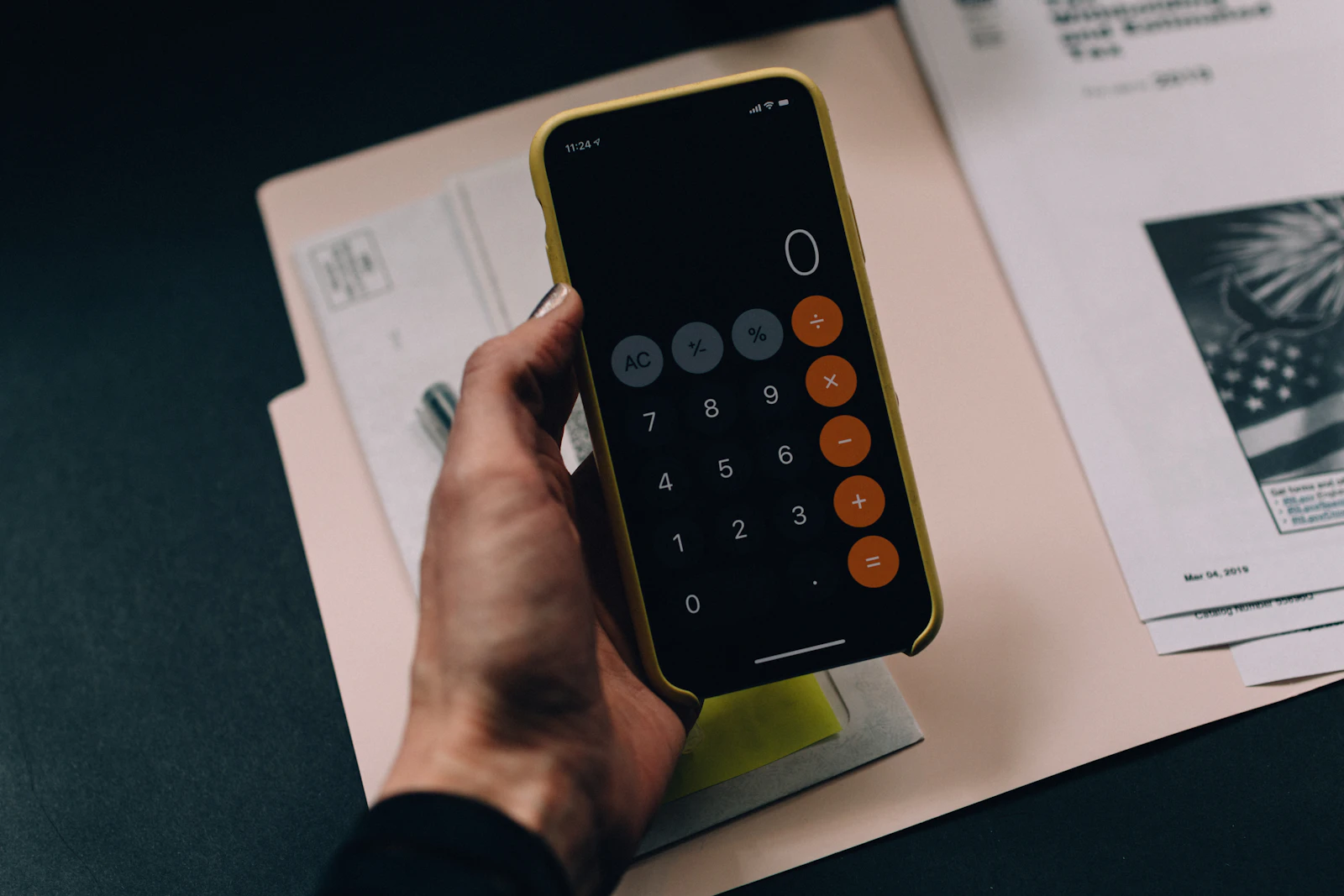
Calculator, notebook, and financial worksheet on a desk — the everyday math behind the new permanent QBI deduction and the $400 minimum that kicks in for tax year 2026
Who counts as an SSTB (and why it matters)
The SSTB classification limits or eliminates the QBI deduction once income crosses the phaseout. Per IRS Section 199A regulations, an SSTB includes (IRS One Big Beautiful Bill provisions):
Health, law, accounting, actuarial science
Performing arts, consulting, athletics
Financial services, brokerage services, investing
Trading or dealing in securities
"Any trade or business where the principal asset is the reputation or skill of one or more of its employees or owners"
That last category is where most solo freelancers land. A freelance copywriter, designer, developer, photographer, or strategist whose business is fundamentally "I sell my expertise" sits inside the SSTB definition.
What this means in 2026:
Below $201,750 (single) or $403,500 (joint) of taxable income — the SSTB classification doesn't bite. You get the full 20% QBI deduction on your QBI.
Inside the phaseout band — the deduction phases down. The exact math is non-trivial; most freelancers in this band benefit from running the calculation through tax software or an accountant.
Above $276,750 (single) or $553,500 (joint) — SSTBs lose the deduction entirely.
Non-SSTB businesses (manufacturers, real-estate landlords, e-commerce sellers, software products) get a different treatment above the threshold — they can still claim the deduction, but it's capped by W-2 wages paid and the unadjusted basis of qualified property.
The practical 2026 planning moves
Three things to actually do, not just read:
Run the calculation now, not in March 2027. Most freelance Schedule C filers will benefit modestly from the $400 minimum. Most who were already taking the regular deduction will see no change in their effective tax bill. But if you're hovering near the phaseout threshold, the expanded window can mean four-figure differences.
Reconsider S-corp election if you skipped it. The QBI deduction is available to sole proprietors, partnerships, and S corporations. C corporations don't qualify. For freelancers earning $70,000–$120,000/year, the S-corp election (with reasonable salary plus distributions) often combines with the QBI deduction for the cleanest tax outcome — and the permanence of QBI removes the "but what about 2026?" objection that delayed many elections.
Track QBI carefully if you have multiple businesses. OBBBA's minimum applies to *aggregate* QBI of $1,000+ from active businesses. If you run a freelance services business and a small e-commerce side hustle, both contribute. Your bookkeeping needs to separate income streams for QBI purposes.
No raise of the deduction rate. Some early OBBBA drafts proposed 23%; the final bill kept it at 20%.
No exclusion of new SSTB categories. Consulting and other reputation-based businesses are still SSTBs subject to phaseout.
No retroactive change. The new rules apply to tax years beginning after December 31, 2025. Your 2025 return (filed in early 2026) follows the old regime.
Frequently asked questions
What is QBI in plain English?
Qualified business income is the net taxable income from your active trade or business after expenses, *excluding* capital gains, dividends, interest income (in most cases), and reasonable compensation paid to S-corp owners. For a freelance Schedule C filer, QBI is roughly your Schedule C net profit. For an S-corp owner, it's the corporate income passed through to your personal return, after subtracting your reasonable W-2 salary.
What's the smallest income where the new $400 minimum starts mattering?
The minimum kicks in once aggregate QBI hits $1,000. Below $1,000 of QBI, no minimum applies. Between $1,000 and $2,000 of QBI, the regular 20% calculation gives $200–$400 and the floor kicks in. Above $2,000 of QBI, the regular calculation already exceeds the floor and the floor is irrelevant.
Does the QBI deduction reduce self-employment tax?
No. The QBI deduction reduces your federal income tax base only. Self-employment tax (15.3% on the first $176,100 of SE income for tax year 2025, with a higher 2026 cap) is calculated separately and is not affected by the QBI deduction.
Can I take the QBI deduction if I take the standard deduction?
Yes. The QBI deduction is a "below-the-line" deduction taken after computing adjusted gross income, and it's available whether you itemize or take the standard deduction. Most freelancers in 2026 will take the QBI deduction *and* the standard deduction.
What if my freelance income is irregular — some years high, some years low?
The QBI deduction is calculated each year independently based on that year's QBI. There's no carryforward of unused deduction capacity from a low-income year to a high-income year. Year-by-year planning matters more than multi-year averaging — though now that the deduction is permanent, the calendar pressure to maximize it before 2026 has gone away.
The takeaway
The QBI deduction was the single most consequential tax provision for solo US freelancers in the TCJA, and it was set to expire at the end of 2025. OBBBA removed that sunset and made three small improvements — the $400 minimum, the expanded phaseout window, and the certainty of permanence — that benefit lower-income freelancers most directly.
For most solo freelancers earning under the phaseout threshold, your 2026 return will look broadly similar to your 2025 return, with roughly the same QBI deduction. What changed is the multi-year planning horizon: Roth conversions, S-corp elections, and retirement contributions can now assume the deduction stays, not that it sunsets.
The freelancers who will get the biggest 2026 benefit aren't the high earners — they're the ones with QBI between $1,000 and $2,000 who'll see the $400 floor lift them above their regular calculation. Five-figure savings? No. But a real, real-money improvement for the bottom of the income distribution that the original TCJA largely missed.
Delivvo is the branded client portal that makes the bookkeeping side of QBI calculations actually tractable — every invoice, deposit, and contract in one place that exports cleanly to your accountant. $15/month, free for 7 days. Tax-time clarity from day one.
D
Written by
The Delivvo team
Delivvo is a client portal for freelancers: deliver work, sign contracts, send invoices, and get paid directly through your own gateway with 0% taken. The team is led by founder Mohammed Bibo.